
 English
  русский
 عربى
عربىLight Blue/Orange Tarpaulin: The Cover That Signals From Both Sides
A tarpaulin usually does one job: keep the weather off what is underneath. A light blue/orange tarpaulin does that and something else. The orange side faces out and catches the eye. The light blue side reflects sunlight and keeps the covered space cooler. The two-color construction is not decoration. It is a working decision for job sites, events, and storage where the tarp has to be seen and the contents have to stay protected.
Orange for Visibility, Light Blue for Heat
The orange side is the safety signal. It marks the edge of a load, the top of a scaffold, or the boundary of a work zone. In low light or bad weather, a dark tarp disappears. The orange stays visible. The factory compounds the orange pigment with UV stabilizers so the color holds through months of direct sun. A faded orange tarp is no longer a warning.
The light blue side faces the sun on hot days. Dark tarps absorb solar radiation and heat the space underneath. Light blue reflects more of the sunlight and keeps the interior cooler. For livestock shelters, event tents, and temporary workshops, the temperature difference matters.
The two colors are applied as separate coatings on each side of the woven fabric. The factory controls the coating weight and the adhesion so the layers do not delaminate when the tarp is folded, dragged, or flapped in the wind.
The Weave Carries the Strength
Under the colored coatings is a woven HDPE fabric. The tape is extruded, stretched, and woven into a grid. The weave density and the tape thickness set the tensile strength. A light blue/orange tarpaulin for a truck cover runs a heavier weave than one for a temporary shade. The factory matches the weave to the weight grade.
The lamination bonds the coatings to the fabric. Temperature and roller pressure determine the bond strength. A tarp that delaminates at the edges loses the coating and the fabric underneath starts to degrade from the UV.
Edges, Grommets, and Reinforcement
A tarp fails at the edge first. The fabric frays, the grommets pull through, the hem opens. The factory finishes the perimeter with a folded, heat-sealed hem that doubles the material thickness where the ropes and bungees attach.
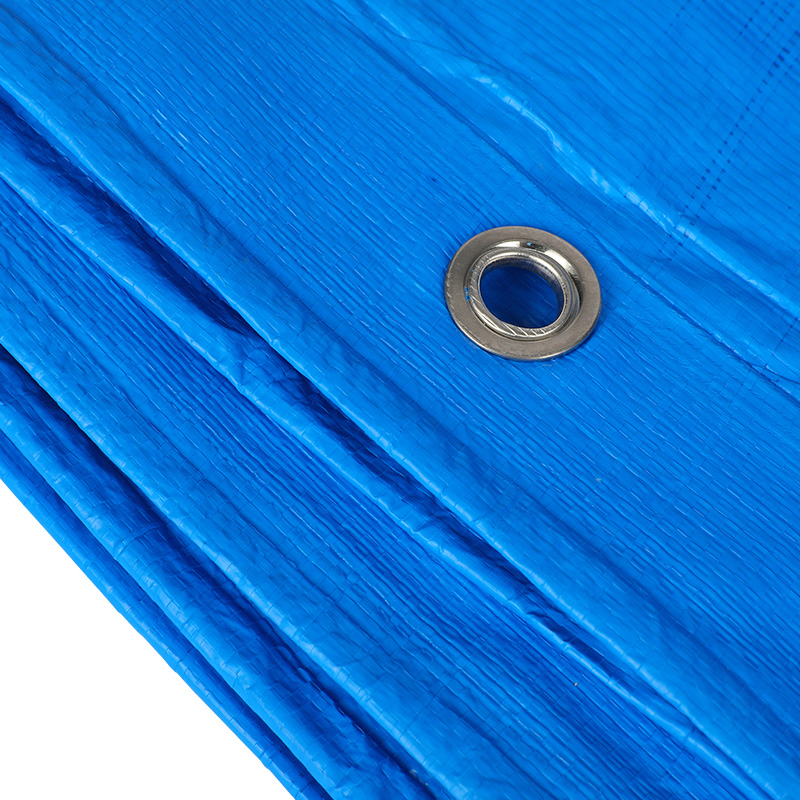
Brass or stainless steel grommets set into the reinforced hem hold the tie-down load. The factory places the grommets at regular intervals and adds corner patches where the stress concentrates. Heavy-duty grades carry a polypropylene rope sealed inside the hem for extra edge strength.
Here is what a light blue/orange tarpaulin needs to deliver:
- UV-stabilized orange pigment that stays visible
- Light blue reflective layer that reduces heat
- Woven HDPE fabric with tensile strength matched to the grade
- Lamination bond that does not delaminate
- Reinforced hem with brass or stainless grommets
- Corner patches or rope reinforcement on heavy grades
Where the Two-Color Tarp Works
Construction sites use the tarp on scaffolding and material piles. The orange faces the work zone. The light blue faces the sun. The workers see the edge. The material stays cooler.
Event and market setups use the tarp as a roof or a wall. The orange side marks the booth. The light blue interior brightens the space underneath.
Trucking uses the tarp to cover the load. The orange side makes the load visible to traffic. The light blue side keeps the cargo cooler on a long haul.
The Tarp That Fades or Peels
The orange fades to pale peach and the safety function disappears. Cheap pigments without stabilizers cause it. The coating peels from the fabric and the weave shows through. A weak lamination bond causes it. The grommets tear out under tension because the hem was too thin. A reinforced hem holds.
A light blue/orange tarpaulin covers, protects, and signals at the same time. The orange side says here I am. The light blue side says I keep it cool. Choose a factory that stabilizes the pigments, bonds the lamination, and reinforces the edges.
Your email address will not be published. Required fields are marked *

Info
+86-15967922255
No. 859, Huafeng Road, Jindong District, Jinhua City, Zhejiang Province, China
Copyright © Jinhua Donglin Tarpaulin Daily Products Co., Ltd.

Double White & Black & Light Blue Tarpaulin